

Conservation Changemakers
GRADE 7-9
UNDERSTAND • QUESTION • COLLABORATE • DESIGN • LEAD
Understanding the world is important. Learning how to help shape its future is the next step.
Conservation Changemakers challenges students to explore conservation as part of a much bigger system — one in which wildlife, ecosystems, people, communities, economies, tourism, development and a changing climate are interconnected.
Designed for Grades 7–9, students investigate real conservation challenges, examine different perspectives, consider the consequences of decisions and explore how solutions can support both people and the natural world.
At this level, there may not always be one simple answer. Students are encouraged to question, analyse, debate, collaborate, design and justify their ideas — developing the confidence to become informed participants in the decisions shaping their future.
The question is no longer only “What is happening — and why?”
It becomes “What should happen next — and how could we help make it possible?”
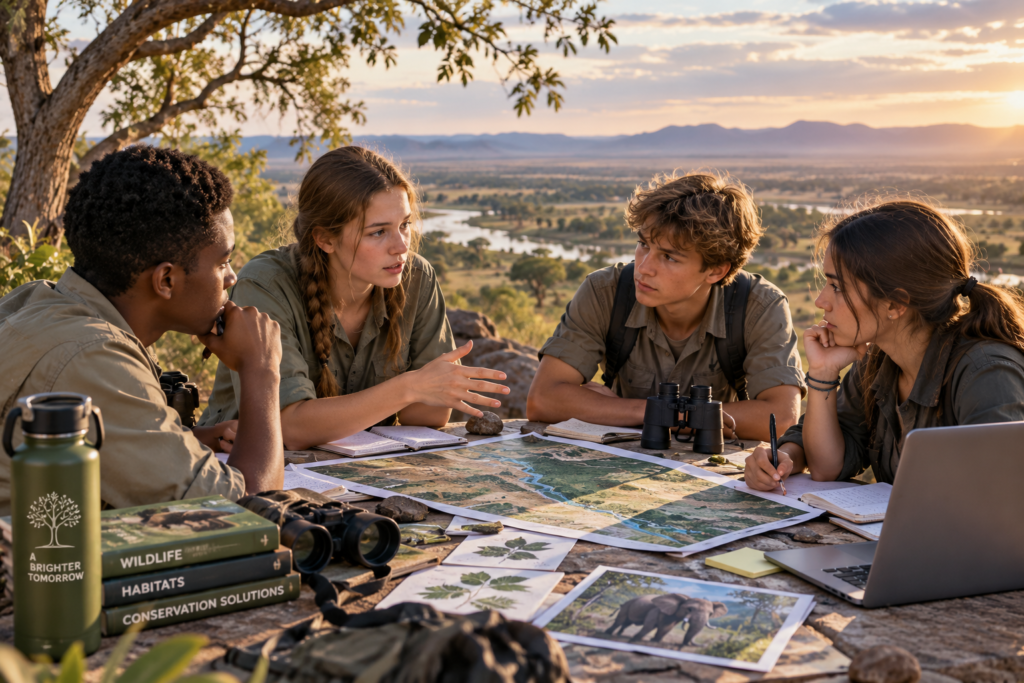
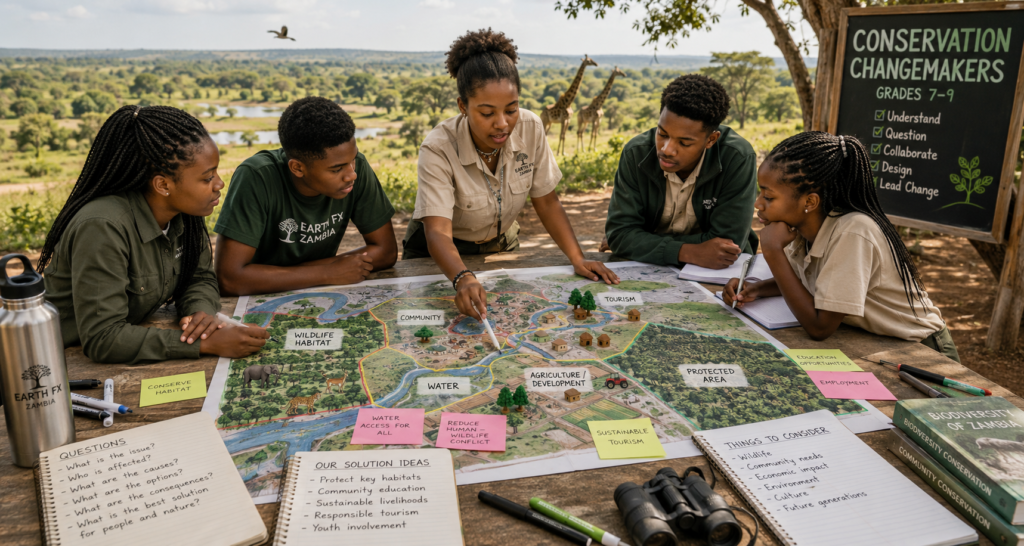
WHAT CONSERVATION CHANGEMAKERS EXPLORE
ECOSYSTEMS & INTERCONNECTION
Explore biotic and abiotic factors, ecosystem relationships and the connections between wildlife, people and the environment. Students examine how change in one part of a system can create consequences elsewhere.
WILDLIFE POPULATIONS & THE BALANCE OF NATURE
Investigate what influences wildlife populations and explore predator-prey relationships, competition, carrying capacity and the delicate balance that supports healthy ecosystems.
ADAPTATION, BIODIVERSITY & A CHANGING CLIMATE
Examine how species adapt to environmental conditions, why biodiversity strengthens ecosystems and how a changing climate may affect wildlife, habitats and communities.
SHARING ZAMBIA — WILDLIFE, PEOPLE & COMMUNITIES
Explore the realities of sharing landscapes with wildlife, including human-wildlife conflict, community needs and the role local people can play in creating lasting conservation solutions.
TOURISM & CONSERVATION DECISIONS
Investigate how tourism, conservation, development and community priorities can intersect. Students consider different perspectives, weigh benefits and consequences, and explore what responsible conservation decisions might look like.
DESIGN THE CHANGE — THE 2037 CHALLENGE
Students bring their learning together to imagine the future. They identify a conservation challenge, consider who and what is affected, evaluate possible solutions and design a change they believe could create a better future for wildlife and people.
Conservation is rarely about choosing between a perfect option and a bad one.
It is about understanding the connections, considering the consequences and making the best-informed decision possible.
LEARNING TO THINK LIKE A CHANGEMAKER
Conservation Changemakers are encouraged to look beyond simple answers and explore the connections, perspectives and consequences behind real conservation challenges.
Students learn to question information, consider evidence, listen to different viewpoints and work collaboratively before deciding what they believe should happen next.
The aim is not to tell young people what to think. It is to give them the knowledge, confidence and skills to think critically, make informed decisions and contribute constructively to change.
UNDERSTAND
See the whole system.
Explore the relationships between wildlife, ecosystems, people, communities, economies and the environment. Identify who and what may be affected by a conservation challenge — and why.
QUESTION
Don’t stop at the obvious answer.
Ask what is happening, why it is happening, what evidence exists, whose perspectives may be missing and what assumptions might need to be challenged.
COLLABORATE
Listen. Discuss. Learn from others.
Consider different perspectives, share ideas respectfully and recognise that stronger solutions can emerge when communities, conservationists, scientists, governments and young people work together.
DESIGN
Turn understanding into possibility.
Develop practical conservation solutions, consider their benefits and limitations, anticipate possible consequences and refine ideas using evidence and feedback.
LEAD
Turn ideas into influence and action.
Leadership doesn’t always mean being the person at the front.
Changemakers lead by asking important questions, sharing knowledge, listening to others, making responsible choices, contributing ideas and having the courage to act when something can be improved.
Students are encouraged to recognize that their voice, choices and ideas have value — and that meaningful change often begins when someone decides to participate.
UNDERSTAND → QUESTION → COLLABORATE → DESIGN → LEAD
A changemaker does not need to have every answer.
A changemaker needs the courage to ask better questions — and the determination to help find better answers.
FOR TEACHERS
Conservation Changemakers is supported by an Earth FX Teacher Guide designed to help educators facilitate critical thinking, evidence-based discussion, collaboration and student-led problem solving.
At Grades 7–9, conservation issues can be explored with greater complexity. Students may encounter competing priorities involving wildlife protection, community needs, tourism, development, livelihoods, culture, climate and economic opportunity.
The teacher’s role is not necessarily to provide the “right” answer. Instead, teachers help students ask stronger questions, examine evidence, consider different perspectives, recognise consequences and explain the reasoning behind their decisions.
Students should also be given permission to disagree. Respectful disagreement is an important part of learning when students can support their position with evidence, listen to other viewpoints and remain willing to reconsider their thinking.
QUESTION • FACILITATE • CHALLENGE • LISTEN • EMPOWER
A strong Changemakers classroom is one where students feel confident saying:
“I see it differently — and this is why.”
They should also become comfortable saying:
“I hadn’t considered that. I might need to rethink my position.”
Both require confidence. Both require respect. And both are important skills for people who will one day participate in decisions affecting communities, wildlife and the environment.
WHEN THERE IS NO SIMPLE ANSWER
Some conservation challenges do not have solutions that benefit everyone equally.
Encourage students to ask:
Who benefits?
Who might be disadvantaged?
What happens to wildlife?
What happens to people?
What are the environmental consequences?
What are the economic consequences?
What might happen in five, ten or twenty years?
Whose voice have we not heard?
Students can then compare possible solutions and explain which approach they would choose — and why.
The goal is not agreement.
The goal is informed, respectful and responsible thinking.
EXPLORE TEACHER RESOURCES →
BEYOND THE WORKBOOK
Learning becomes powerful when students are given the opportunity to use it.
Conservation Changemakers takes students beyond understanding conservation challenges and asks them to imagine what could happen next.
Students identify a real conservation issue or opportunity, investigate the evidence, consider who and what is affected, listen to different perspectives and explore possible responses.
Then comes the challenge:
Design a solution that could create meaningful change.
The solution does not need to be enormous. It needs to be thoughtful, realistic, evidence-informed and capable of making something better.
DESIGN THE CHANGE — THE 2037 CHALLENGE
Imagine the year is 2037.
What would you like your community, wildlife, environment — and your world — to look like?
What needs to change between now and then?
The 2037 Challenge invites students to choose a conservation challenge and develop a proposal for the future they believe is possible.
1. DEFINE THE CHALLENGE
What needs to change?
Identify the issue clearly. What is happening? Where is it happening? Why does it matter? Who or what is affected?
2. INVESTIGATE THE EVIDENCE
What do we actually know?
Research, observe, compare information and distinguish evidence from assumptions. Identify what is known — and what still needs to be understood.
3. IDENTIFY THE STAKEHOLDERS
Whose lives, livelihoods or futures are involved?
Consider wildlife, communities, landowners, conservation organisations, businesses, tourists, governments and future generations where relevant.
4. CONSIDER THE CHOICES
What could we do — and what might happen if we do it?
Develop several possible responses. Consider the benefits, limitations, costs, risks and unintended consequences of each.
5. DESIGN THE CHANGE
What is our proposed solution?
Choose or create the approach students believe offers the strongest outcome. Explain how it would work, what would be needed and how wildlife, people and the environment would be affected.
6. PRESENT & DEFEND
Why should others support this idea?
Students present their proposal, explain the evidence behind their decisions, answer questions and respond respectfully to challenges or alternative viewpoints.
REFLECT, REFINE & REIMAGINE
After receiving feedback, students reconsider their proposal.
What did others see that we didn’t?
Has new evidence changed our thinking?
Could our solution be improved?
Would we make the same decision now?
Changemakers learn that changing or improving an idea after receiving new information is not failure — it is part of good decision-making.
UNDERSTAND → INVESTIGATE → LISTEN → DECIDE → DESIGN → PRESENT → REFLECT
Don’t just imagine a better future.
DESIGN ONE.
IDEAS DESERVE TO BE HEARD
Where appropriate, student proposals can move beyond the classroom.
Classes may share ideas with their school, families, community organisations, conservation groups, local businesses or decision-makers. Students can create presentations, displays, campaigns, letters, videos, models or community proposals that communicate what they have discovered and what they believe could change.
Earth FX also envisions opportunities for students in different communities and countries to share conservation challenges, exchange ideas and learn from one another — recognising that while the challenges may be different, the responsibility for our shared future belongs to all of us.
A student’s idea may begin in a classroom.
There is no reason it has to end there.
THIS IS YOUR GENERATION OF CHANGE.
Understand the challenge.
Question what is possible.
Listen to others.
Design something better.
Have the courage to lead.
Conservation Changemakers — Grades 7–9
Understand • Question • Collaborate • Design • Lead