

TEACHING CONSERVATION. EMPOWERING CHANGE.
Great conservation education begins with a teacher who is willing to explore alongside their students.
Earth FX Teacher Resources are designed to give educators the guidance, confidence and flexibility to deliver meaningful conservation learning in real classrooms.
From early discovery through to investigation, critical thinking and student-led conservation solutions, our resources support teachers at every stage of the Earth FX learning journey.
You don’t need to be a wildlife expert, scientist or conservationist. The resources provide the structure — while teachers bring something equally important: knowledge of their students, their community and the world immediately around them.
You don’t need to know every answer.
You need to create a classroom where students are encouraged to keep asking questions.
ONE FRAMEWORK. THREE LEVELS OF TEACHING
GRADES 1–3
GUIDE DISCOVERY
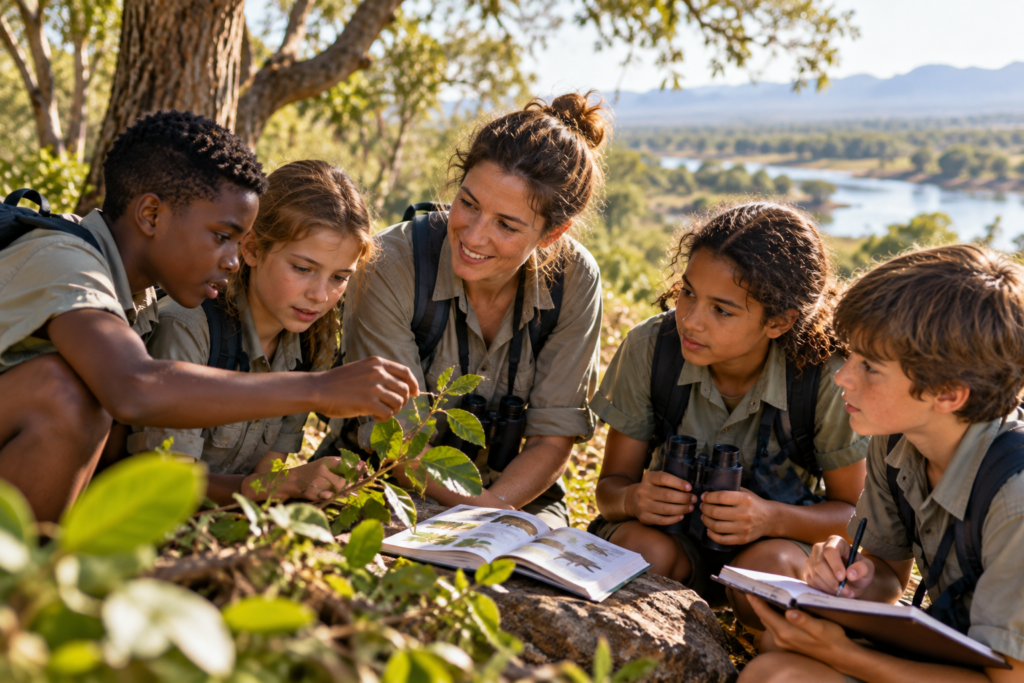
Encourage curiosity, observation and wonder as students begin exploring wildlife, habitats and the natural world.
GRADES 4–6
GUIDE INVESTIGATION
Help students ask deeper questions, investigate evidence, recognise patterns and understand how ecosystems and conservation challenges are connected.
GRADES 7–9
GUIDE CHANGE
Facilitate discussion, critical thinking and collaboration as students examine complex conservation challenges, consider different perspectives and develop possible solutions.
As students grow, the teacher’s role evolves too.
From guiding discovery → to facilitating investigation → to empowering independent thinking and action.
EVERYTHING A TEACHER NEEDS TO BEGIN
Getting started is simple
01
CHOOSE THE PATHWAY
Select the learning level that best suits your students and curriculum needs.
02
EXPLORE THE RESOURCES
Use the Teacher Guide, student materials and supporting activities to plan your learning.
03
MAKE IT YOUR OWN
Adapt discussions, investigations and activities to your classroom, community and local environment.
04
MOVE FROM LEARNING TO ACTION
Help students turn what they discover into questions, ideas, decisions and meaningful action.
The Teacher Guide is not a script.
It is a framework designed to give teachers the confidence and flexibility to make conservation learning work in their own classroom.
Teacher Lesson Guides
Clear lesson guidance connected directly to student workbook pages.
Discussion & Question Prompts
Questions that encourage curiosity, investigation, critical thinking and meaningful classroom conversation.
Practical & Outdoor Activities
Flexible learning activities using the classroom, school grounds and surrounding environment.
Beyond the Workbook
Ideas that help teachers turn classroom learning into student-led conservation action.
Teacher Preparation Checklist
A simple tool to help educators prepare resources, activities and learning environments before delivery.
Assessment & Observation
A way for teachers to record what worked, what students discovered and how the program can continue to improve.
Adaptation Guidance
Ways to deliver the same learning goal across different resources, abilities, environments and classroom contexts.
TEACH WITH WHAT YOU HAVE
Meaningful conservation education does not depend on expensive equipment, sophisticated technology or access to the internet.
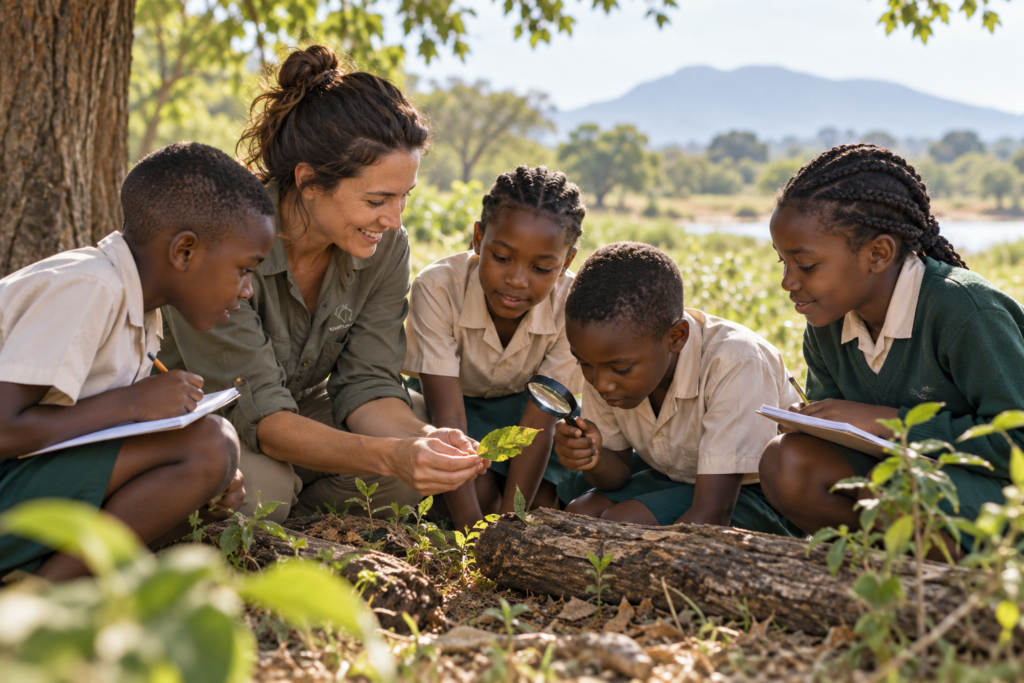
Earth FX resources are designed so teachers can begin with what is already around them — their classroom, school grounds, local environment, community knowledge and the curiosity of their students.
A tree can become an ecosystem investigation. A bird outside the classroom can begin a discussion about adaptation. A patch of soil can reveal biotic and abiotic connections. A leaking tap can become a water conservation investigation. A conversation with a community elder can bring local environmental knowledge into the classroom.
The environment around the school is not separate from the learning. It can become part of the classroom.
ADAPT THE METHOD — PROTECT THE LEARNING GOAL
Every classroom is different. Schools have different timetables, resources, class sizes, learning needs and local contexts. Kids for Conservation is designed with that reality in mind.
Activities, discussions and investigations can be adapted to suit your students, curriculum and available resources without losing the purpose of the learning.
You know your students best. Use the resources in the way that works for your classroom.
The activity can change. The learning goal remains.

ADAPT THE ACTIVITIES
Shorten, extend or modify activities to suit lesson time, learning needs and available resources.

MEET YOUR STUDENTS
Choose examples, discussions and approaches that are relevant and meaningful to the students in front of you.
USE YOUR LOCAL CONTEXT
Connect learning with local wildlife, environments, communities and conservation issues students can recognise and explore.

KEEP THE CORE GOAL
However the method changes, keep the learning purpose clear: understanding, critical thinking, compassion and meaningful action.
FLEXIBILITY CREATES OPPORTUNITY
Adaptation isn’t about doing less. It is about making learning accessible, relevant and achievable for different students, classrooms and communities.
Same learning goal. Different pathways to reach it.
INCLUDE EVERY LEARNER
Students do not all learn, communicate or contribute in the same way.
Some students will confidently lead discussions. Others may observe quietly and notice details their classmates miss. Some communicate best through writing, while others demonstrate understanding through drawing, building, movement, conversation, investigation or practical action.
Teachers are encouraged to create multiple ways for students to participate and demonstrate learning — recognising that contribution does not have to look the same for every child.
DIFFERENT STRENGTHS. DIFFERENT WAYS TO CONTRIBUTE.
THE OBSERVER
THE RESEARCHER

THE PROBLEM-SOLVER

THE QUESTIONER

THE STORYTELLER
THE QUIET THINKER
THE ARTIST
THE ORGANISER

THE LEADER
Conservation needs them all.
Inclusion is not about lowering expectations. It is about creating different pathways for students to reach meaningful learning.
ASSESSMENT & OBSERVATION
Assessment in Kids for Conservation is designed to help teachers recognise learning as it develops — through what students understand, the questions they ask, the connections they make and the ways they apply their thinking.
Students may demonstrate learning through discussion, written work, investigation, observation, creative responses, collaboration, problem-solving and practical action.
The goal is not simply to measure what a student remembers. It is to recognise how their understanding is growing.
LOOK FOR LEARNING IN ACTION
UNDERSTANDING
Can the student explain key ideas and make connections between wildlife, people, ecosystems and conservation?
QUESTIONING & INVESTIGATION
Does the student ask meaningful questions, gather information, examine evidence and reconsider ideas?
THINKING & DECISION-MAKING
Can the student consider different perspectives, recognise consequences and explain the reasoning behind their choices?
PARTICIPATION & ACTION
How does the student contribute, collaborate, communicate ideas and apply learning through practical or proposed action?
ASSESS PROGRESS, NOT PERFECTION.
What matters is not that every student demonstrates learning in the same way, but that each student has opportunities to show growing understanding.
TEACHER REFLECTION
EVERY CLASSROOM TEACHES US SOMETHING
Kids for Conservation is designed to evolve through the experiences of the teachers and students who use it.
After a lesson, investigation or project, teachers are encouraged to take a moment to consider not only what students learned, but what captured their curiosity, what challenged their thinking and what helped them connect with the issue.
Reflection does not need to be lengthy or formal. A few thoughtful observations can help shape what happens next — in the next lesson, the next investigation and across the wider Kids for Conservation program.
WHAT CONNECTED?
What sparked curiosity, conversation or enthusiasm? What did students respond to most strongly?
WHAT CHALLENGED?
Where did students hesitate, question, disagree or need more support? Did anything change their thinking?
WHAT COMES NEXT?
What could be explored further, adapted or turned into action? What questions are students still asking?
YOUR EXPERIENCE HELPS SHAPE OURS
Kids for Conservation is not intended to remain static. Teacher observations and feedback can help Earth FX understand what works across different classrooms, communities and countries — and where the program can continue to improve.
Every classroom adds something to what we know.
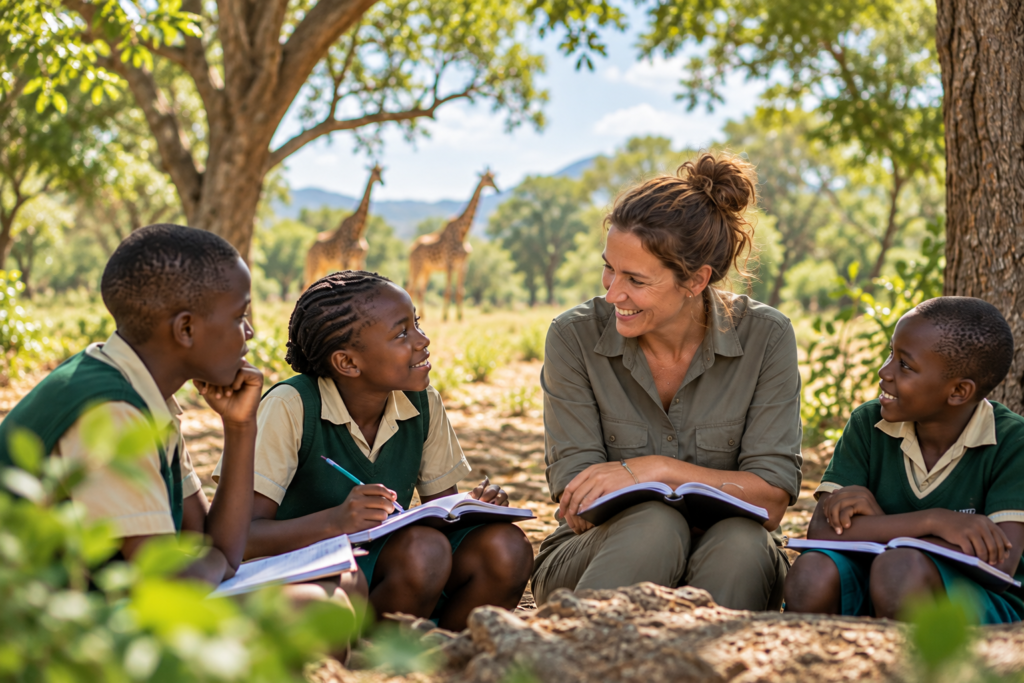
SUPPORTING TEACHERS
You are not expected to do this alone.
Kids for Conservation is designed to support teachers, not add another complicated program to an already busy classroom.
The Teacher Guides, lesson ideas, discussion prompts, assessment tools and supporting resources provide a starting point. Teachers can use what is useful, adapt what is needed and build the program into the learning already taking place in their classroom.
And when questions, ideas or challenges arise, Earth FX wants to hear them. Teacher feedback helps us improve resources, understand what different schools need and continue developing Kids for Conservation alongside the educators who bring it to life.
Good conservation education is not built for teachers. It is built with them.
RESOURCES
Practical guides, lesson ideas, discussion prompts and assessment tools to help you begin.
GUIDANCE
A flexible framework that can be adapted to your students, curriculum, resources and local context.
CONNECTION
An ongoing relationship with Earth FX that allows teachers to share experiences, ideas and feedback as the program grows.
.
FROM THE CLASSROOM TO CONSERVATION
LEARNING IS ONLY THE BEGINNING
Kids for Conservation is designed to help students move beyond learning about conservation and begin considering how knowledge, choices and action are connected.
The teacher’s role is not to provide every answer or determine what students should care about. It is to create opportunities for students to investigate, question, consider different perspectives and decide what meaningful action might look like in their own context.

LEARN
Build knowledge and curiosity.
PLAN
Turn ideas into achievable steps.
INVESTIGATE
Encourage questions and explore evidence.
ACT
Create opportunities for meaningful participation.

CHOOSE
Help students identify what matters to them.

SHARE
Give students a voice and audience.

REFLECT
Consider what changed, what was learned and what could happen next.
The goal is not to tell students what to think.
It is to give them the knowledge, skills and confidence to think deeply, make informed choices and participate in their conservation future.
Education today. Conservation tomorrow.