

Conservation Investigators
GRADES 4-6
THINK • INVESTIGATE • UNDERSTAND • ACT
Curiosity becomes powerful when children begin asking why.
Conservation Investigators takes students beyond discovering the natural world and begins exploring how it works, why it changes and what happens when one part of a system is affected.
Designed for Grades 4–6, students investigate ecosystems, wildlife populations, adaptation, biodiversity and a changing climate while exploring the connections between wildlife, people and the environment.
Rather than simply being given answers, students are encouraged to observe, question, investigate evidence, recognise patterns, make connections and consider possible solutions.
The question is no longer only “What is this?”
It becomes “Why is this happening — and what can we learn from it?”
ECOSYSTEM CONNECTIONS
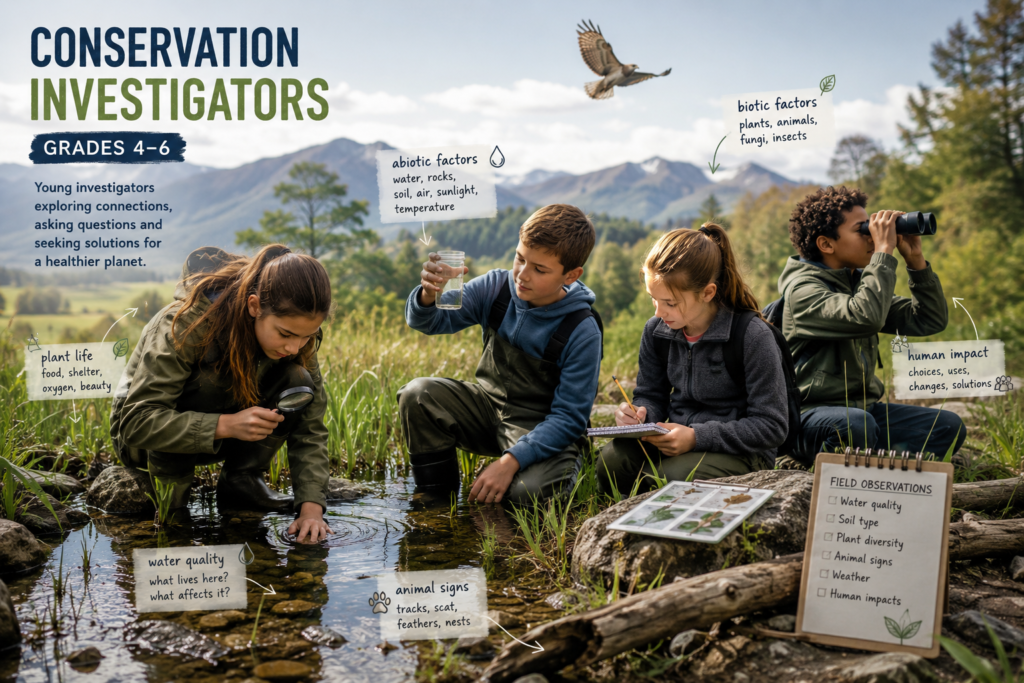
Explore biotic and abiotic factors and investigate how plants, animals, water, soil, sunlight and climate interact to form functioning ecosystems.
WILDLIFE POPULATIONS
Discover why wildlife populations grow, decline or remain stable, and investigate how food, water, habitat, predators, competition and human activity can affect the balance of nature.
ADAPTATION & SURVIVAL
Investigate the physical and behavioural adaptations that help wildlife survive — and consider what happens when environments begin to change.
BIODIVERSITY & A CHANGING CLIMATE
Explore why biodiversity matters, how changing environmental conditions can affect species and ecosystems, and why resilient ecosystems are important for the future.
SHARING ZAMBIA — WILDLIFE & PEOPLE
Investigate how people and wildlife share landscapes, the challenges this can create, and how communities can become part of conservation solutions.
CONSERVATION SOLUTIONS
Move from identifying problems to considering possibilities. Students explore how evidence, community knowledge, conservation action and everyday choices can contribute to practical solutions.
Everything in an ecosystem is connected.
When one part changes, other parts may change too.
LEARNING THROUGH INVESTIGATION
Conservation Investigators move beyond simply learning facts. Students are encouraged to think critically, ask questions, gather information, examine evidence, recognise patterns and make connections.
Through investigation, students begin to understand that conservation challenges rarely have just one cause — and that good solutions begin with understanding how different parts of a system are connected.
THINK
Ask why. Notice patterns. Make connections.
Students consider what they already know, identify what they want to understand and begin asking questions about wildlife, ecosystems and environmental change.
INVESTIGATE
Look closer. Gather evidence. Explore possibilities.
Students observe, research, compare and investigate information to discover what may be happening and why.
UNDERSTAND
Connect the evidence. See the bigger picture.
Students use what they have discovered to understand relationships between wildlife, people and the environment — and recognize that changing one part of a system can affect many others.
ACT
Turn understanding into meaningful action.
Students consider practical responses, make informed choices and identify actions they can take individually or together.
Good conservation begins with good questions.
Investigate first. Understand the connections. Then decide what action could make a difference.
FOR TEACHERS
Conservation Investigators is supported by an Earth FX Teacher Guide designed to help educators turn curiosity into inquiry, investigation and meaningful discussion.
Teachers are provided with lesson guidance, discussion prompts, investigation ideas, assessment support and practical activities that encourage students to examine evidence, recognise connections and consider different perspectives.
The program is designed to be flexible. Investigations can begin with the environment immediately around the school — a tree, patch of soil, water source, insect population, changing weather pattern or evidence of human activity can all become opportunities for conservation learning.
Teachers don’t need to provide every answer. Their role is to help students ask better questions, investigate what they find and think carefully about what the evidence might mean.
QUESTION • GUIDE • INVESTIGATE • DISCUSS • EMPOWER
As students begin forming their own opinions, teachers can create space for different ideas, respectful discussion and evidence-based thinking — helping young people understand that conservation decisions often involve wildlife, people, communities and environments together.
BEYOND THE WORKBOOK
Conservation learning becomes more powerful when students take what they have discovered and use it to investigate something happening in the world around them.
Conservation Investigators are encouraged to look beyond the workbook and identify a question, issue or opportunity within their school, home or local community.
It might begin with noticing litter around the school, fewer insects in one area, water being wasted, a lack of habitat for birds, damage to vegetation, changes in a local waterway or simply wondering why certain animals are found in one place but not another.
Rather than immediately deciding on a solution, students are encouraged to investigate first — because understanding what is happening helps us make better conservation decisions.
FROM QUESTION TO ACTION
NOTICE & QUESTION
What have we noticed — and what do we want to understand?
Students identify something in their environment that interests or concerns them and turn their observations into a question they can investigate.
INVESTIGATE
What can we discover?
Observe, count, compare, research, photograph, map or record information. Look for patterns and gather evidence before reaching conclusions.
UNDERSTAND
What might the evidence be telling us?
Students compare what they found, consider possible causes and make connections between wildlife, people and environmental conditions.
CHOOSE & ACT
What could we realistically do?
Use what has been learned to choose a practical response — individually, as a class or together with the school or community.
REFLECT & SHARE
Did our action make a difference? What changed? What did we learn? What might we do differently next time?
Students share their findings and reflect on both the outcome and the investigation itself.
QUESTION → INVESTIGATE → UNDERSTAND → ACT → REFLECT → SHARE
AN INVESTIGATION CAN START ANYWHERE
Students might investigate:
🐦 Wildlife at school — Which birds, insects or other animals use the school grounds, and what attracts them?
💧 Water use — Where is water being used or wasted, and could anything be improved?
🌿 Habitat — Does the school provide food, water, shelter and space for local wildlife?
🗑️ Waste — What types of waste does the class or school produce, and where does it go?
🌡️ Microclimates — Are some parts of the school hotter or cooler than others, and why?
🤝 People and nature — How do people use a local natural area, and what effects might that have?
The goal isn’t to tell students what to think.
It is to give them the skills to investigate, understand and make informed choices.
CURIOSITY BECOMES UNDERSTANDING.
Ask the question.
Follow the evidence.
Understand the connections.
Choose what happens next.
Conservation Investigators — Grades 4–6
Think • Investigate • Understand • Act